Festival sound, explained for civilians
Stand at the back of a good festival, Borneo Jazz on the Miri waterfront, the Rainforest World Music Festival in its clearing at the foot of Mount Santubong, and the strange thing isn't that it's loud. It's that it's clear. The double bass sounds like a double bass at a hundred metres. That clarity is engineered, and it's worth understanding, if you're a listener wondering what you're hearing, or a planner wondering what you're paying for.
Chapter 01The line array: why the speakers hang in a curve
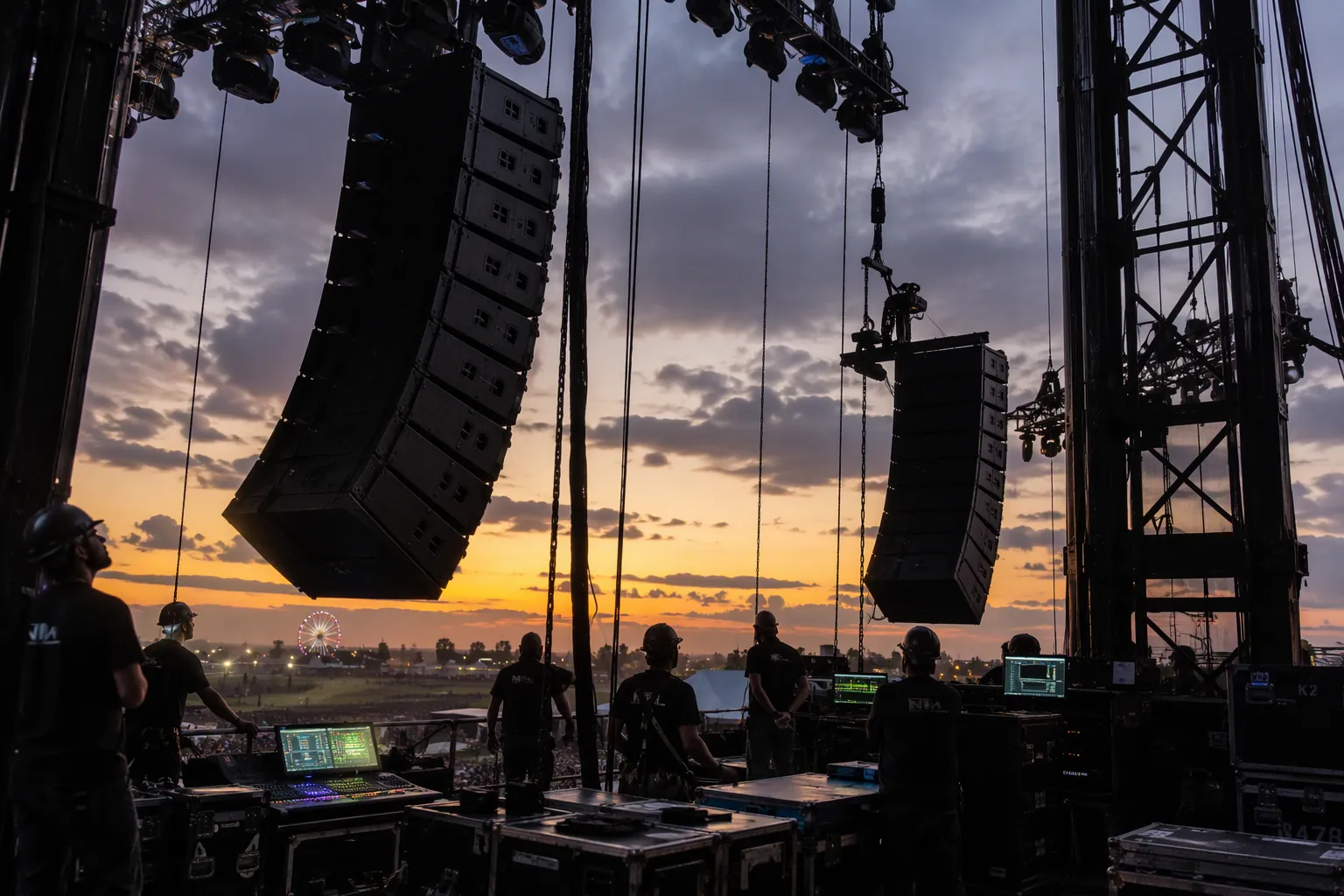
The banana shaped columns flanking a festival stage are line arrays: stacks of identical loudspeakers that couple acoustically. A single speaker sprays sound in a widening cone that dies quickly with distance. A vertical column of them behaves differently.
The boxes reinforce each other along the column's axis, projecting sound far forward while keeping the vertical spread tight and steerable. Curve the column (the "J" shape you see from the side) and the engineer can aim the top boxes at the far field and the bottom boxes at the near rows, evening out the level between front rail and back fence.
The aim: coverage shaped like the audience, not like a light bulb. Systems from manufacturers like L-Acoustics and d&b audiotechnik dominate the festival world precisely because their prediction software lets an engineer model the field (every seat, every metre) before a single box leaves the truck.
Chapter 02Delay towers: the speakers in the middle of the crowd
Sound is slow. It covers roughly 34 centimetres per millisecond, so a listener 100 metres from the stage hears the band about a third of a second late. Past a certain distance, two things go wrong: the main arrays run out of clean reach, and any supplementary speaker you add arrives earlier than the stage sound, smearing everything into echo.
The fix is the delay tower: those lone stacks standing in the audience. Each is fed the same mix, electronically delayed so its sound arrives in sync with the wavefront from the stage. Your brain fuses the two into one image: the band sounds like it's coming from the stage, but with the presence of a speaker twenty metres away. When a festival "sounds good everywhere," this is often why.
Good festival sound isn't loud. It's on time.
Chapter 03Weather: the mixing engineer's silent opponent
Outdoor sound is at the mercy of the air it travels through. Wind bends sound: a cross breeze can push high frequencies off axis and open up dead pockets where the vocal seems to vanish. Temperature gradients do the same thing at dusk: as the ground cools, sound refracts. A system tuned at 3pm in equatorial heat is a slightly different instrument by the 9pm headliner, and festival engineers walk again the field between acts for exactly this reason.
A coastal site like Miri's waterfront adds its own signature: steady sea breeze, high humidity (which helps high frequencies travel), and no walls, meaning the low end dissipates instead of building up. Subwoofers outdoors are often arrayed in cardioid configurations that cancel bass backward toward the stage and push it forward, keeping the drummer's world and the audience's world separate.
Chapter 04Why jazz is the hardest gig on the calendar
An EDM act hands the engineer a finished stereo signal, loud, compressed, consistent. A jazz band hands them open microphones on acoustic instruments with a volume range that spans brushed snare up to full throated tenor sax. Every dB of amplification is a fight against feedback; every quiet passage is a test of the system's noise floor and the audience's manners. The engineer's job at a jazz festival is preservation, not production: get out of the way of the dynamics at a hundred metre scale.
It's why the same festival site can feel like a different venue depending on the bill, and why the engineers who do jazz well are prized the way mastering engineers are. When you hear a ballad carry across the Miri waterfront at midnight, pin drop quiet, you're hearing the hardest thing the rig can do.